New to Python or setting up a fresh environment? Here's where to begin — the official sources, package managers, and tools every Python developer needs.
🐍
Download Python
The official CPython interpreter. Python 3.14 is the current stable release; 3.15 lands October 2026. Python 3.9 is end-of-life and 3.10 retires in October 2026 — target 3.12 or newer. Includes pip out of the box.
The Python ecosystem has options for everything. Here's how the top tools stack up — one tab at a time.
pandas
The original. Massive ecosystem, every tutorial uses it. pandas 3.0 (Jan 2026) made copy-on-write and PyArrow-backed strings the defaults and added the pd.col expression API — but it needs Python 3.11+ and is still single-threaded and eager. Best under 5 GB.
Prototyping
Polars
Rust-powered, multi-threaded by default. Roughly an order of magnitude faster than pandas above ~1 GB. Lazy evaluation, Arrow memory, streaming sinks, and free-threaded Python support. Needs Python 3.10+.
Performance
Modin
Drop-in pandas replacement. Change one import line, get multi-core parallelism via Ray or Dask. Zero rewrite.
Quick Win
Dask DataFrame
Pandas-like API for datasets larger than memory. Partitions data across cores or clusters. 10 GB – 1 TB sweet spot.
Scale Out
Start with pandas for learning. Move to Polars for speed. Use Modin for quick wins on existing code. Use Dask when data exceeds memory.
PySpark
Enterprise standard for big data (10 TB+). SQL-first, mature ecosystem. Runs on Databricks, EMR, Dataproc, Fabric. Spark 4.2 is the current release; 4.x needs Python 3.10+, Java 17+, and Scala 2.13.
Enterprise
Dask
Pure Python distributed computing. Familiar NumPy/pandas APIs. Scales from laptop to cluster. Lower overhead than Spark.
Python-Native
Ray
General-purpose distributed framework. Not just data — distributes any Python function. Excels at ML training and custom parallelism.
ML / General
PySpark for enterprise big data and SQL-heavy workloads. Dask for Python-native medium-scale analytics. Ray for ML training and general-purpose parallelism.
scikit-learn
Classical ML: classification, regression, clustering. Clean API, great docs, no GPU needed. The standard for tabular data.
Classical ML
PyTorch
Deep learning framework. Dynamic graphs, Pythonic feel, dominant in research. Powers most LLMs and computer vision models.
Research
TensorFlow
Google's deep learning framework. Strong production deployment (TF Serving, TF Lite). Keras for high-level modeling.
Production
scikit-learn for classical ML on tabular data. PyTorch for research and custom deep learning. TensorFlow for production deployment at scale.
Great Expectations
Python-native data validation. Define "expectations" as code, run them against any DataFrame or database. Programmatic data contracts.
Python-First
dbt Tests
Built into dbt. SQL-based tests against your warehouse. Schema tests, custom SQL, freshness checks.
SQL-Centric
Soda
YAML-based data quality checks. SodaCL language. Integrates with Airflow, dbt, Spark. Simple and declarative.
Declarative
Great Expectations for Python-native data contracts. dbt tests if you're already in the dbt ecosystem. Soda for quick, declarative monitoring.
Airflow
The industry standard. DAG-based scheduling, massive operator library. Managed on AWS, GCP, Azure. Battle-tested at scale.
Standard
Prefect
Modern alternative. Pythonic API, dynamic workflows, built-in retries and caching. Less boilerplate than Airflow.
Modern
Dagster
Software-defined assets. Type-checked I/O, built-in data lineage. Think in terms of data assets, not tasks.
Asset-Centric
Airflow for enterprise-scale deployment. Prefect for Pythonic simplicity. Dagster for asset-centric data engineering.
Apache Iceberg
Open table format. Time travel, schema evolution, partition evolution. Vendor-neutral, backed by Apple/Netflix/AWS. The emerging standard.
Standard
Delta Lake
Databricks-originated. ACID transactions on Parquet. Deep Spark integration. Strongest on Databricks.
Databricks
Apache Hudi
Optimized for streaming upserts and incremental processing. Record-level updates without rewriting partitions.
Streaming
Iceberg for vendor-neutral data lakes. Delta Lake for Databricks shops. Hudi for streaming upsert workloads.
AI-Powered Development
The AI coding tool landscape
From autocomplete to fully autonomous agents — here's the 2026 landscape at a glance.
AI IDE
Cursor
Full AI IDE on a VS Code fork. Composer for multi-file edits, Agent mode for autonomous tasks. 1M+ users. The most polished experience.
Best for: Daily coding with AI
Terminal Agent
Claude Code
Terminal-based AI agent by Anthropic. 1M token context. Reads your codebase, edits files, spawns parallel sub-agents. Deepest reasoning.
Best for: Complex refactors & architecture
IDE + Extension
VS Code + Copilot
World's most popular editor with GitHub Copilot. Tab-complete, inline chat, massive extension ecosystem. Multi-model support.
Best for: Enterprise & stability
Agentic IDE
Windsurf
Pioneered "agentic coding" with Cascade. Multi-step agent that self-corrects. SWE-1.5 model. Now part of Google ($2.4B).
Best for: Budget-friendly AI
Agentic Platform
Google Antigravity
Google's agentic dev platform on the Windsurf codebase. Editor + Manager view for multi-agent orchestration. Still in preview.
Best for: Multi-agent & GCP teams
Data Engineering
PyFluent Studio
Deterministic AST parsing + AI augmentation. Column-level lineage, STTM, visual execution, auto-docs. On-premise. No hallucinations.
Best for: PySpark & data engineering
Scaling Python
Single-core to cluster
Python's GIL means one CPU core at a time. Here's how to go around it — at every scale.
Single Machine
Optimize First
Vectorize with NumPy/pandas — avoid Python loops over data
Use Polars (Rust, multi-threaded, no GIL problem)
Profile with cProfile before parallelizing
Often 10x faster without any parallelism
Multi-Core
Go Parallel
multiprocessing — separate processes, each with its own GIL
Modin — change one import, get parallel pandas
Polars — automatic multi-threading via Rust
Python 3.14 — free-threaded build (no GIL) is now officially supported
Ray — distribute any Python function. ML training, serving
PySpark — enterprise big data standard (10 TB+)
All run on Databricks, EMR, Dataproc, or bare metal
PySpark Platforms
Where to run PySpark
Five platforms dominate PySpark workloads. Each makes different trade-offs on pricing, Spark versions, serverless, and cloud lock-in. Apache Spark 4.2.0 is the current upstream release — here's who has caught up as of August 2026.
Per-second billing, $0.053/vCPU-hr. Zero cluster management. Deepest AWS integration (S3, Glue Catalog, Lake Formation). Iceberg v3 support. EMR 7.13 is still on Spark 3.5.6 — Spark 4 arrives through the separate emr-spark-8.0 runtime.
Lowest entry cost for ad-hoc PySpark.
Cloud Analytics
Google Cloud Dataproc
Now branded Managed Service for Apache Spark. Image 3.0 (July 2026) brings Spark 4.1.2, Python 3.12, and Java 21. Native BigQuery integration — read/write BigQuery directly from PySpark. Vertex AI integration. Per-second billing.
Best for GCP and BigQuery pipelines.
Unified Analytics
Microsoft Azure/h3>
Runtime 2.0 is GA on Spark 4.1, Delta Lake 4.2, and Python 3.13 — it becomes the default in late September 2026, when Runtime 1.3 (Spark 3.5.5, Python 3.11) enters LTS. One platform for PySpark + SQL + Power BI + ML, with OneLake and Copilot in notebooks.
Best for Microsoft-centric organizations.
Hybrid & On-Premises
Cloudera CDE / CDP
The only platform with genuine on-premises support. True hybrid/multi-cloud. Ranger + Atlas governance. Iceberg support. Built-in Airflow. Still Spark 3.5.4 / Python 3.11 — no Spark 4 line yet.
Best for regulated industries and data sovereignty.
Development & Lineage
PyFluent Studio — For All Platforms
Sits on top of any PySpark platform. Deterministic column-level lineage, visual execution, auto-docs. Convert SAS/DataStage to PySpark.
All migrations powered by PyFluent Studio's deterministic AST parser — no hallucinations, 100% reproducible. Column-level lineage verification ensures every transformation is provably correct.
Which Python and Spark versions run on every major cloud platform. Verified against vendor release notes in August 2026 — upstream PySpark now requires Python 3.10 or newer.
Platform
Runtime
Spark
Python
Databricks
Runtime 19
4.2.0
3.12
Databricks
Runtime 18 LTS
4.1.0
3.12
Databricks
Runtime 17.3 LTS
4.0.0
3.12
Databricks
Runtime 16.4 LTS
3.5.2
3.12
Databricks
Runtime 15.4 LTS
3.5.0
3.11
AWS EMR
EMR 7.13
3.5.6
3.11 (3.9 also shipped)
AWS EMR Serverless
emr-spark-8.0
4.0.x
3.9 – 3.12
GCP Dataproc
Image 3.0
4.1.2
3.12
GCP Dataproc
Image 2.3
3.5.x
3.11
Microsoft Azure/strong>
Runtime 2.0
4.1
3.13
Microsoft Azure/strong>
Runtime 1.3
3.5.5
3.11
Cloudera
CDE / Runtime 7.3.2
3.5.4
3.11
Snowflake
Snowpark
N/A
3.10 – 3.13 (3.14 preview)
Apache Spark
PySpark 4.2.0 (upstream)
4.2.0
3.10+
PyFluent Studio
Two engines, one modernization platform
A deterministic parser that never hallucinates, paired with an AI engine that knows your codebase. The parser always has the final word — the same architecture that powers MigryX across SAS, COBOL, Alteryx, and DataStage.
Deterministic Engine
Parser-Driven Modernization
AST-based, compiler-grade analysis of Python code. Same input always produces the same output. Column-level lineage, STTM, code conversion — all 100% reproducible.
Parses Python, PySpark, pandas, SQL at the AST level
Column-level lineage without annotations
Source-to-Target Transformation Mapping (STTM)
Code conversion: Python/pandas to PySpark, Polars, Snowflake, Databricks
Framework modernization: pandas to Polars, PySpark, and back
AI Engine
Context-Aware Augmentation
AI that knows your codebase, lineage, and data flows. Suggests, explains, and generates — but the parser always validates. AI never has the final word on correctness.
Natural-language code generation with pipeline context
Auto-generates documentation and data dictionaries
Debug errors with lineage-aware fixes
Code optimization suggestions with before/after
Runs entirely inside your environment
Deployment
Self-service modernization. On your infrastructure.
No consultants, no external dependencies. Deploy PyFluent behind your firewall — or use it on the MigryX SaaS portal. Your code and data never leave your network.
100%
Reproducible parsing
0
Data leaves your network
15 min
Install to first lineage
6
Integrated modules
Visual Platform
See everything. Control everything.
A visual development environment where lineage updates in real time, execution is step-by-step, and documentation writes itself.
🔗
Live Lineage as You Type
A lineage graph updates in real time beside your code. Trace every column's origin and catch broken dependencies before you run anything.
⚡
Visual Execution
Run pipelines step-by-step on Databricks and Snowflake. See exactly where execution stops, what failed, and why.
📚
Learn While You Build
Auto-generated docs, inline AI explanations, and STTM tables teach your team as they work. Junior developers write senior-quality code.
📊
Interactive Data Previews
Inline table views, schema cards, and distribution charts beneath each step. Explore data visually without writing profiling code.
📄
Auto Documentation
Docstrings, data dictionaries, and pipeline docs generated from real code and lineage. Always accurate, always current.
🔧
One-Click Export
Export to production Python modules, FastAPI endpoints, Airflow DAGs, or Spark jobs. Clean, typed, production-ready output.
Visual Lineage & Metrics
Auto Documentation
Platform Walkthrough
From legacy Python to modern platform in 5 steps
How PyFluent modernizes your Python codebase — from analysis through validated production deployment.
Step 01 — Analyze
Import & understand your codebase
Import Python, PySpark, pandas, or SQL code. The deterministic parser extracts column-level lineage, STTM, and project metrics automatically.
Automatic AST parsing of entire codebases
Project-level metrics and complexity analysis
Dependency mapping across files and modules
Project metrics and analysis dashboard
Step 02 — Modernize
Convert & modernize frameworks
The deterministic parser converts between Python frameworks while preserving data lineage. Modernize pandas to Polars or PySpark, optimize queries, and target cloud platforms.
Framework modernization: pandas to Polars, PySpark, Snowflake
Query optimization with lineage context
Performance recommendations with before/after
AI-powered optimization with lineage context
Step 03 — Build
Visual development with live lineage
Write code in the visual editor with a real-time lineage graph beside you. See exactly how data flows through your pipeline as you type.
Live lineage updates as you edit code
Inline data previews and schema cards
AI-assisted code generation with context
Visual editor with real-time lineage graph
Step 04 — Validate
Deterministic data validation
Run validation checks against your data. Compare source and target at the column level. The deterministic engine ensures 100% reproducible results.
Column-level source-to-target matching
Automated regression testing
Data quality checks with clear pass/fail
Deterministic data validation results
Step 05 — Deploy
AI assistant for production readiness
The AI assistant helps you prepare code for production. Auto-generates documentation, suggests error handling, and exports to your target platform.
Export to Airflow DAGs, Spark jobs, FastAPI
Auto-generated deployment documentation
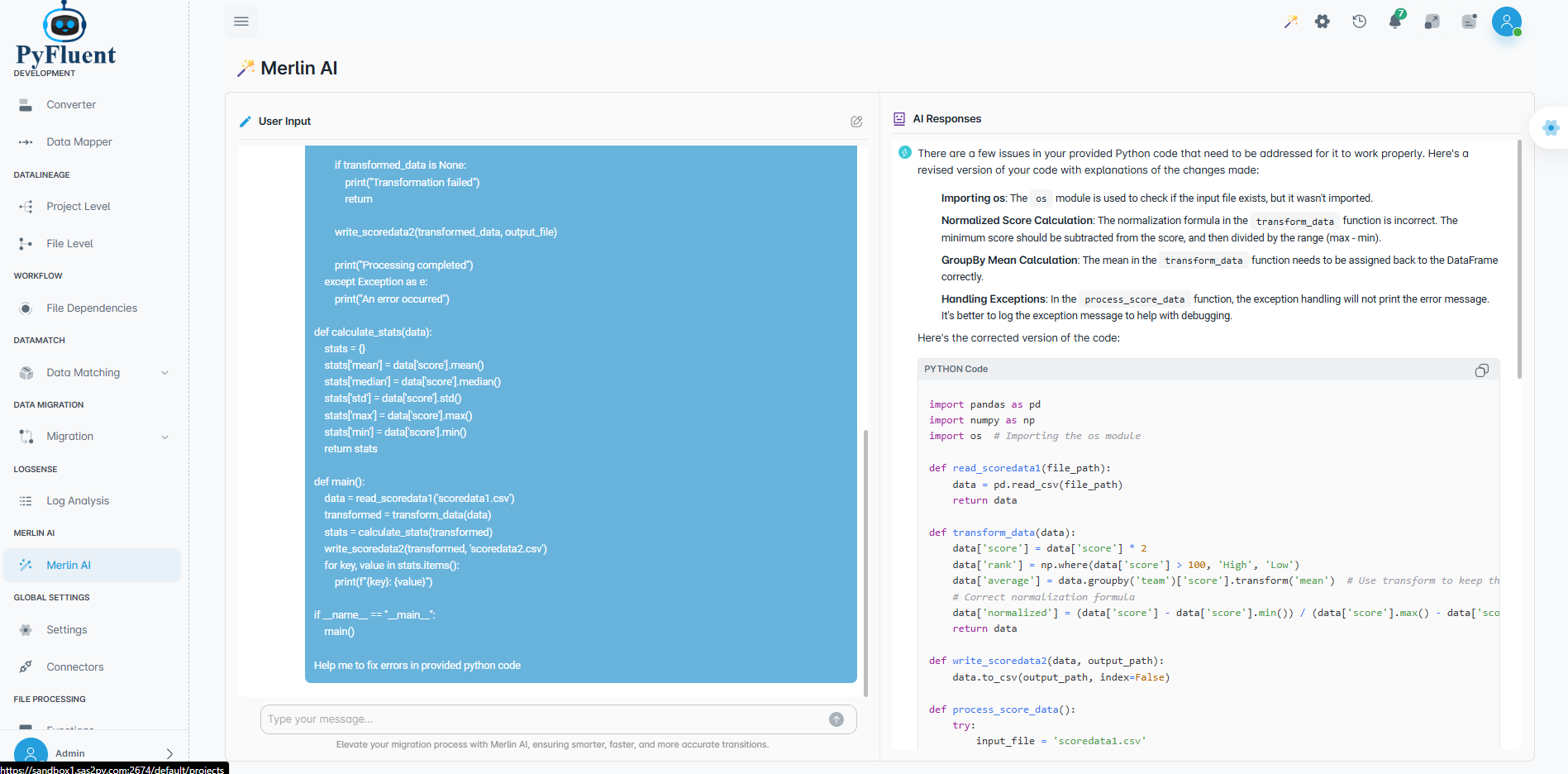
Production readiness checklist
AI assistant for production deployment
Platform Modules
Six integrated modules, one platform
Everything you need to analyze, modernize, trace, validate, document, and execute Python code — without stitching together a dozen tools.
Risk & Complexity Analysis
Automated complexity scoring, dependency risk heatmaps, and technical debt quantification across your entire codebase.
Visual Lineage
Interactive column-level lineage graphs. Trace any output column back to its source through every transformation. No annotations required.
Code Conversion
Convert Python/pandas to PySpark, Polars, Snowflake, and Databricks — or convert SAS, DataStage, BTEQ, and SQL into Python. Deterministic parsing ensures accurate, reproducible output.
Data Mapping (STTM)
Automatic Source-to-Target Transformation Mapping. Every column's journey from source to target, extracted by the parser — not generated by AI.
Auto Documentation
Docstrings, data dictionaries, pipeline docs, and compliance reports — generated from actual code and lineage. Always accurate, never stale.
Data Matching & Validation
Column-level source-to-target data comparison. Automated regression testing. Deterministic validation with clear pass/fail results.
Visual Execution
Step-by-step execution on your cloud
Run pipelines on Databricks and Snowflake with full visibility. See exactly where execution stops and why.
Why PyFluent
What makes PyFluent different
Built from the ground up for deterministic correctness. The same parser architecture that powers MigryX across SAS, COBOL, and Alteryx — now for Python modernization.
Deterministic
No Hallucinations
Column-level STTM is extracted by the parser, not generated by AI. 100% reproducible. Run it Monday or Friday — identical results every time.
On-Premise
Your Data Never Leaves
Deploy behind your firewall. Air-gap ready. No telemetry, no phone-home. Source code and lineage stay in your network. Always.
Self-Service
Your Team Runs It
No consultants needed. Install, connect data sources, and be productive the same day. The visual editor makes onboarding effortless.
Complete
One Platform, Not 12 Tools
Analysis, conversion, lineage, validation, documentation, and execution. No stitching Jupyter + Airflow + Great Expectations + dbt + custom scripts.
Visual
See the Data Flow
Interactive lineage graphs, step-by-step execution, data previews, and schema cards. Understand your pipeline at a glance, not by reading 10,000 lines of code.
Enterprise
Built for Regulated Industries
Full audit trails, compliance reports, GDPR/CCPA data mapping, and SOX controls. The platform your compliance team will thank you for.
Governance & Compliance
Built for regulated environments
On-premises deployment, full column-level audit trails, and auto-generated compliance reports.
GDPR Article 30CCPA Data MappingBCBS 239SOX IT ControlsHIPAA Data LineageSR 11-7 (Banking)OpenLineage StandardOn-Premise / Air-Gapped
Get Started
Start modernizing with PyFluent
No training required. No professional services. Use the MigryX SaaS portal or install in your own environment — and your team is productive today.
15 Minutes
Install & Connect
Deploy the PyFluent Docker image on your servers. Connect to Databricks, Snowflake, S3, or local files. The deterministic parser starts indexing immediately.
Day 1
See & Understand
Open the visual editor. Lineage graphs and STTM tables are already generated. AI explains your code and auto-generates documentation.
Week 1
Modernize & Validate
Modernize legacy Python code. Run visual execution on your cloud platform. Validate with deterministic data matching. Ship with confidence.
Ongoing
Learn & Scale
Every developer writes better Python because the platform teaches them. Lineage stays current. Documentation never goes stale.
The IDE built for the Python ecosystem
Deterministic parsing, AI augmentation, visual lineage, and auto-documentation. All on your infrastructure.